1.4 What the CCEP Credential Is and How You Earn It
The Certified Cannabis Edibles Professional credential is offered by the National Career Certification Board, or NCCB. A credential is a formal way of proving you have the knowledge to do a job well. The NCCB does not teach the training; that is what this book is for. Instead, the NCCB gives the exam and awards the certification when you pass. Think of it like a driving test: a school teaches you to drive, but an official test proves you are ready for the road.
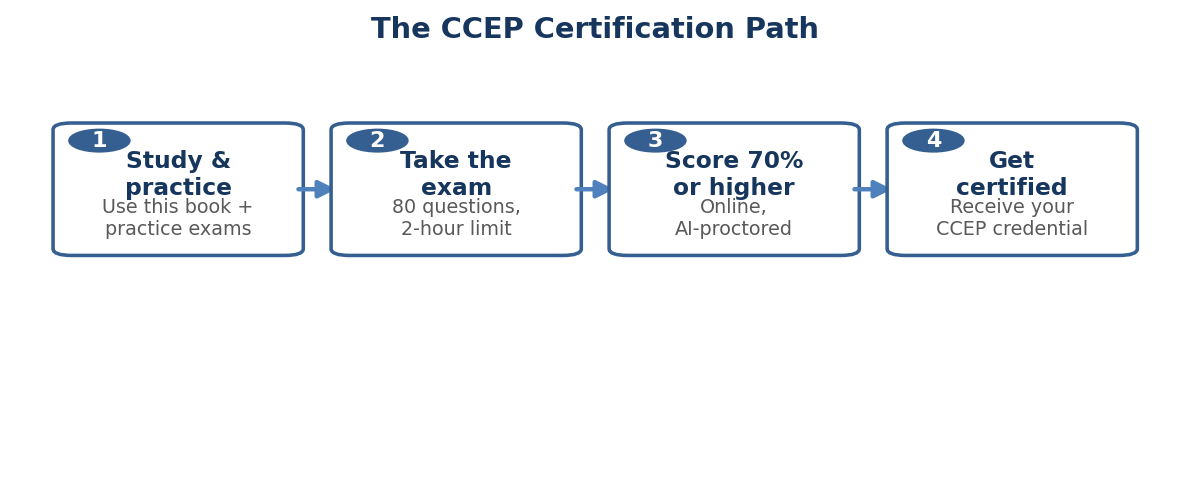
Here is how the path works, step by step. You study and practice using this book. When you feel ready, you take the certification exam. The exam has eighty questions and a two hour time limit, and it is taken online with secure, computer based proctoring. If you score seventy percent or higher, you pass and receive your official CCEP certificate. The figure below lays out the journey.
We will build a complete study plan together in the final chapter, so you will know exactly how to get ready.
Why earn the credential at all? Because it opens doors. A CCEP credential tells an employer that you understand safe dosing, food safety, and compliance before you ever step into their kitchen. It can mean more job offers, higher pay, and more trust. In a growing industry where safety is everything, that proof of skill is powerful. It also shows something money cannot buy: that you take this work seriously and care about doing it right.
What It Means to Be a Professional
Skills matter, but so does how you carry yourself. Being a professional in this field means a few clear things. It means you respect the rules even when no one is watching. It means you keep your workspace clean and your records honest. It means you put the customer’s safety ahead of speed or shortcuts. And it means you keep learning, because this industry changes quickly.
I bring this up in Chapter 1 on purpose. The habits you start with tend to stick. If you build careful, honest habits from your very first batch, they will carry you through your whole career. Employers notice the person who measures twice, labels clearly, and never cuts corners on safety. That person becomes the one they promote and the one they pay more. Professionalism is not about being fancy; it is about being someone people can count on.
A Look at the Road Ahead
Let me give you a map of the journey we are about to take together. Knowing where we are headed makes each step feel clearer, and it shows you how the four core skills come together piece by piece. Here is a short preview of every chapter in this book.
In Chapter 2, we study the cannabis plant itself. You will meet the main cannabinoids, like THC and CBD, and learn about terpenes, the natural compounds that give cannabis its smell and flavor. You will also learn why raw cannabis must be changed before it can work in an edible. This is the science that everything else stands on.
In Chapter 3, we follow an edible through the body. You will learn why edibles take longer to work than smoking, why they often feel stronger, and why the effects last for hours. This is where the famous advice “start low, go slow” comes from, and understanding it will make you a safer maker and a better guide for customers.
In Chapter 4, we cover decarboxylation, a long word for a simple idea: gently heating cannabis to turn it on. You will learn the right temperatures and times, and the common mistakes that ruin a batch. In Chapter 5, we put that activated cannabis to work through infusion, making cannabutter, cannabis oil, and more. Together, these two chapters teach the first core skill, infusion.
In Chapter 6, we tackle the heart of the job: dosing and potency. You will learn the simple math that tells you how much THC is in each serving, and why even mixing matters so much. In Chapter 7, we focus on food safety and the commercial kitchen, because everything you make is food first. In Chapter 8, we bring it all together with recipe development, where you design real products and learn how flavor and innovation fit in.
In Chapter 9, we dig into packaging, labeling, and compliance, the rules that keep products legal and customers informed. In Chapter 10, we cover quality control and product testing, including how labs check potency and safety. And in Chapter 11, we focus on you: your career, the basics of starting a business, professional ethics, and a complete plan to prepare for your CCEP exam. By the end, all four pillars, infusion, creating, dosing and compliance, and innovation, will be standing strong.
Do not worry about remembering all of that now. I just want you to see that there is a clear, sensible path from where you are today to a certified, confident professional. We will walk it one chapter at a time.