Chapter 1 Wrap-up
Chapter summary
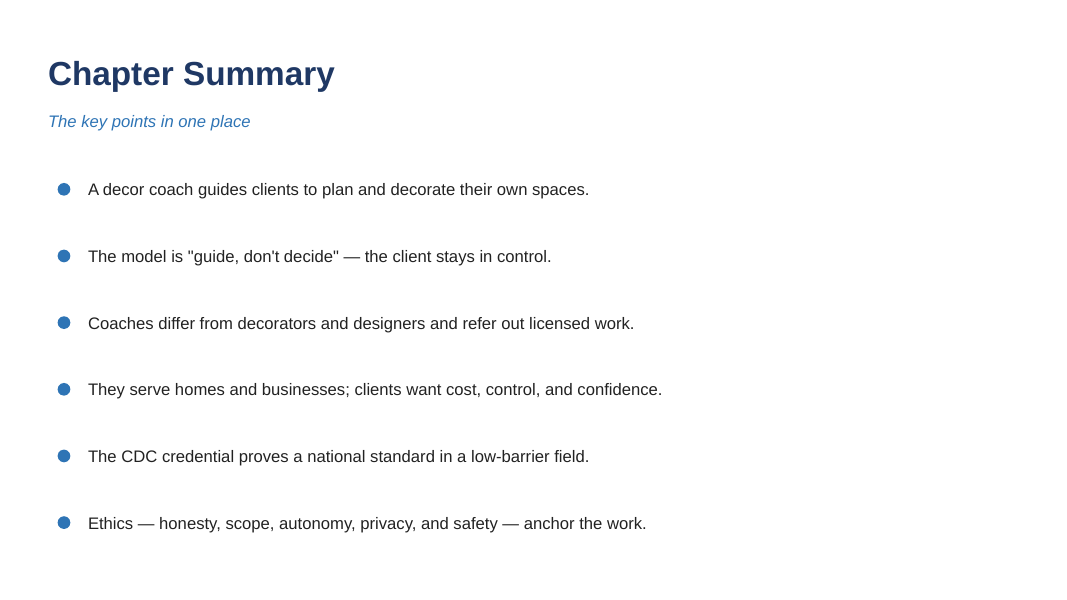
A decor coach helps people plan and decorate their own spaces. The coach supplies the knowledge — color, layout, lighting, furniture, and style — while the client keeps control and makes the final decisions. The guiding idea is “guide, don’t decide.” This client-led approach leaves people with both a beautiful room and the confidence to keep going.
The role is a hybrid of decorator and teacher, and it is different from the jobs around it. A decorator improves the look of a finished space. An interior designer goes further, planning structure and systems, and is often licensed and regulated through practice acts and title acts. A decor coach works in the decorator’s lane but adds teaching and guidance, and refers out any work that requires a licensed professional.
Decor coaches serve both homes and small businesses. Clients choose coaching for its lower cost, the control it gives them, and the confidence it builds. The Certified Decor Coach (CDC) credential from NCCB proves a coach meets a national standard across residential and commercial work — valuable precisely because the field has such a low barrier to entry.
Above all, decor coaching rests on ethics: honesty about money and limits, staying within scope, respecting the client’s right to decide, protecting privacy, and keeping spaces safe. These habits protect clients and build the trust that makes a coaching career last.

Key terms
| Term | Definition |
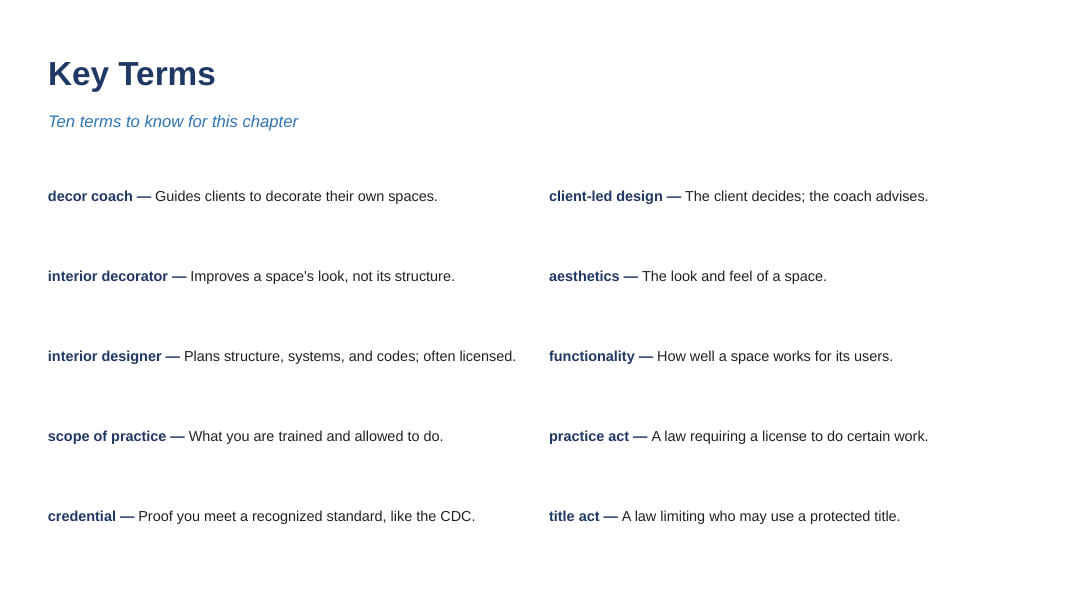
| decor coach | A professional who guides clients to plan and decorate their own spaces, building their skill and confidence. |
| interior decorator | A professional who improves the look and feel of an existing space without changing its structure. |
| interior designer | A trained, often licensed professional who plans how a space functions, including structure, systems, and codes. |
| scope of practice | The range of tasks a professional is trained and legally allowed to perform. |
| credential | An official proof, such as the CDC, that a person meets a recognized standard of knowledge or skill. |
| client-led design | An approach in which the client makes the final decisions while the coach advises and teaches. |
| aesthetics | The look and feel of a space — how beautiful and pleasing it is. |
| functionality | How well a space works for the people who use it. |
| practice act | A law requiring a license to perform certain professional work, such as interior design. |
| title act | A law that limits who may use a protected title, such as “registered interior designer.” |
References
-
International Interior Design Association (IIDA). “Defining the Interior Designer.” iida.org.
-
National Council for Interior Design Qualification (CIDQ). Interior design definition and regulation resources. cidq.org.
-
U.S. Bureau of Labor Statistics. “Interior Designers,” Occupational Outlook Handbook. bls.gov.
-
National Career Certification Board (NCCB). “Decor Coach Certification (CDC).” nccboard.org.
-
Americans with Disabilities Act (ADA) Standards for Accessible Design. U.S. Department of Justice. ada.gov.