Chapter 1 Wrap-up
Chapter summary
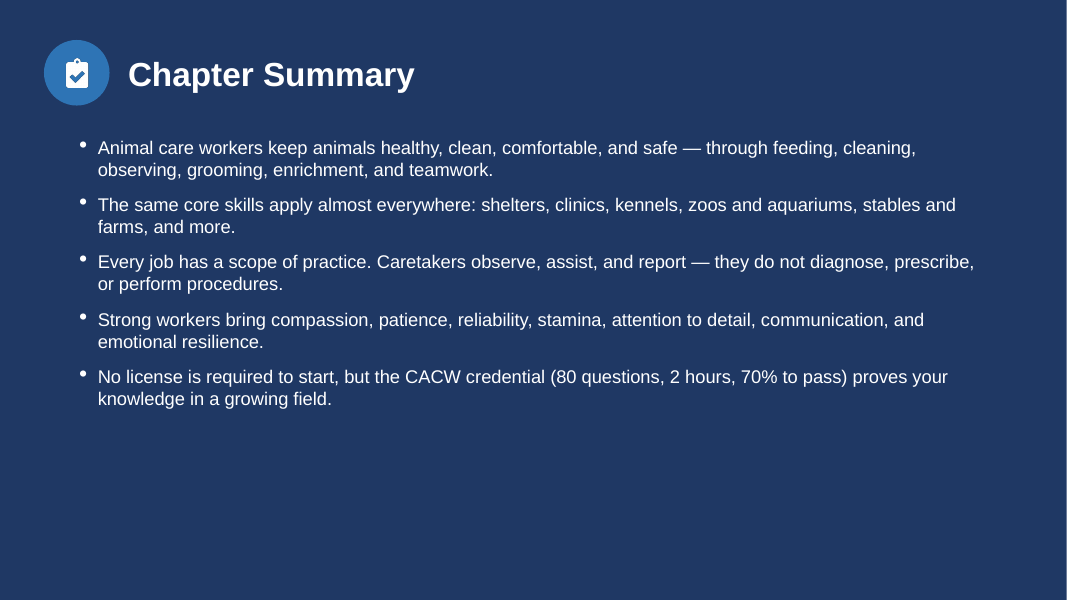
Animal care workers keep animals healthy, clean, comfortable, and safe. Their daily work centers on a handful of core tasks: feeding and watering, cleaning and sanitation, observing and recording, grooming and handling, and providing exercise and enrichment — all while supporting a larger team. These same core skills are needed almost everywhere animals are kept, which makes an animal care worker’s training valuable across many workplaces.
Those workplaces include animal shelters, veterinary clinics, boarding kennels, zoos and aquariums, and stables and farms, along with pet stores, research facilities, and wildlife centers. Each setting has its own feel, but the goals stay the same: feed the animals well, keep their homes clean, watch them closely, and handle them safely. Learning those things well lets you work almost anywhere.
Every animal care job has a scope of practice — a lane to stay in. Animal care workers observe, assist, and report, but they do not diagnose, prescribe, or perform medical procedures. Those tasks belong to veterinary technicians and, above all, to veterinarians. Staying in your lane protects the animal, protects you, and protects trust. Knowing your workplace’s rules and asking when unsure keeps everyone safe.
Strong animal care workers bring compassion, patience, reliability, physical stamina, attention to detail, good communication, and emotional resilience. And while no license is required to start, the Certified Animal Care Worker (CACW) credential from NCCB proves your knowledge to employers. It is an 80-question, two-hour online exam that you pass with a score of 70 percent or higher. In a growing field, that proof — plus a habit of always learning — can open the door to a long and rewarding career with animals.
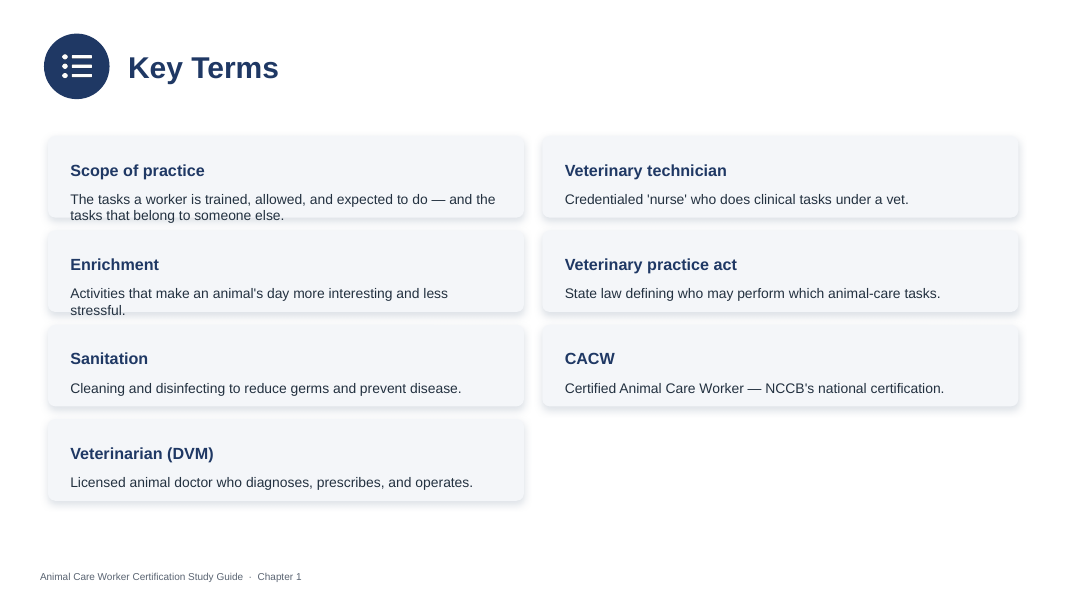
Key terms
|
References
American Veterinary Medical Association. (n.d.). Veterinary technicians and veterinary assistants. Retrieved 2026, from https://www.avma.org/resources/pet-owners/yourvet/veterinary-technicians-and-veterinary-assistants
National Career Certification Board. (2026). Animal Care Worker Certification (CACW). Retrieved 2026, from https://nccboard.org/
U.S. Bureau of Labor Statistics. (2025). Animal care and service workers. Occupational Outlook Handbook. Retrieved 2026, from https://www.bls.gov/ooh/personal-care-and-service/animal-care-and-service-workers.htm
U.S. Bureau of Labor Statistics. (2025). Veterinary assistants and laboratory animal caretakers. Occupational Outlook Handbook. Retrieved 2026, from https://www.bls.gov/ooh/healthcare/veterinary-assistants-and-laboratory-animal-caretakers.htm
U.S. Department of Labor, O*NET OnLine. (2024). 39-2021.00 – Animal Caretakers. Retrieved 2026, from https://www.onetonline.org/link/summary/39-2021.00