Chapter 1 Wrap-up
Chapter summary
Physical therapy helps people move better, manage pain, and heal from injury, illness, or surgery. It works because a whole team works together around the patient. It does not work because one person carries the whole job alone.
The physical therapist evaluates patients and builds the plan of care. The physical therapist assistant carries out that plan under supervision. The physical therapy aide supports both of them by preparing treatment areas, helping patients move safely, watching and reporting what they see, and keeping the administrative side of the clinic running.
Each role has a different education path and a different scope of practice, but all three are needed. A clinic without a well-trained aide falls behind schedule and faces safety risks. It also asks its licensed staff to spend time on tasks that pull them away from patient care.
PT aides work in outpatient clinics, hospitals, inpatient rehabilitation centers, skilled nursing facilities, and sports medicine settings. Wherever they work, the core skills are the same. Those skills are safety, communication, attentiveness, and organization.
Marcus’s story in this chapter is a good one to hold onto. He did not need a license or a clinical degree to make a real difference for a patient. He needed to pay attention, know his role, and speak up at the right moment. The rest of this book will build each of those skills, one chapter at a time.
Return to the five learning objectives at the start of this chapter. You should now be able to define physical therapy and describe what an aide does day to day. You should be able to explain how the aide role differs from the PT and PTA roles. You should be able to describe why the aide matters and name the settings where aides work. If any of those still feel shaky, that is completely normal on a first read, so reread that section before moving on, because Chapter 2 builds right on this base.
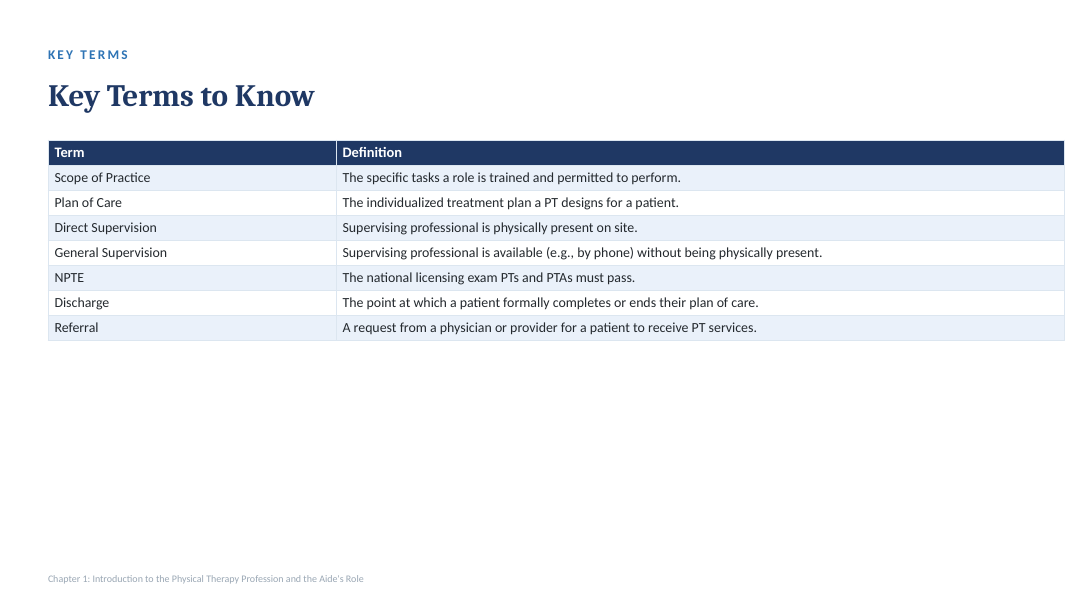
Key terms
Use this table as a quick-reference glossary. You will see these terms again throughout the book. Many of them will show up again on your certification exam.
| Term | Definition |
| Physical Therapy | A health care profession focused on restoring movement, managing pain, and improving function after injury, illness, or surgery. |
| Physical Therapist (PT) | A licensed health care provider who evaluates patients and designs their plan of care. |
| Physical Therapist Assistant (PTA) | A licensed or certified professional who carries out the PT’s plan of care under supervision. |
| Physical Therapy Aide | A support team member who assists with clinical and administrative tasks; does not require a license. |
| Scope of Practice | The specific tasks a role is trained and permitted to perform. |
| Plan of Care | The individualized treatment plan a PT designs for a patient. |
| Licensure | Official government permission required to practice certain health care roles, such as PT and PTA. |
| Supervision | Oversight by a licensed professional under whose direction certain tasks are performed. |
| Direct Supervision | A supervision arrangement in which the supervising professional is physically present on site. |
| General Supervision | A supervision arrangement in which the supervising professional is available, such as by phone, without being physically present. |
| National Physical Therapy Examination (NPTE) | The national licensing exam physical therapists and physical therapist assistants must pass. |
| Certification | A voluntary credential, such as the NCCB Physical Therapy Aide certification, that shows an individual has mastered a body of knowledge. |
| Discharge | The point at which a patient formally completes or ends their plan of care. |
| Referral | A request from a physician or other provider for a patient to receive physical therapy services. |
References
U.S. Bureau of Labor Statistics. Occupational Outlook Handbook: Physical Therapist Assistants and Aides.
O*NET OnLine. Summary Report for: 31-2022.00 – Physical Therapist Aides.
American Physical Therapy Association (APTA). Becoming a Physical Therapist Assistant.
Federation of State Boards of Physical Therapy (FSBPT). NPTE Candidate Handbook.
National Career Certification Board (NCCB). Physical Therapy Aide Certification (CPTA).