Chapter 1 Wrap-up
Chapter summary
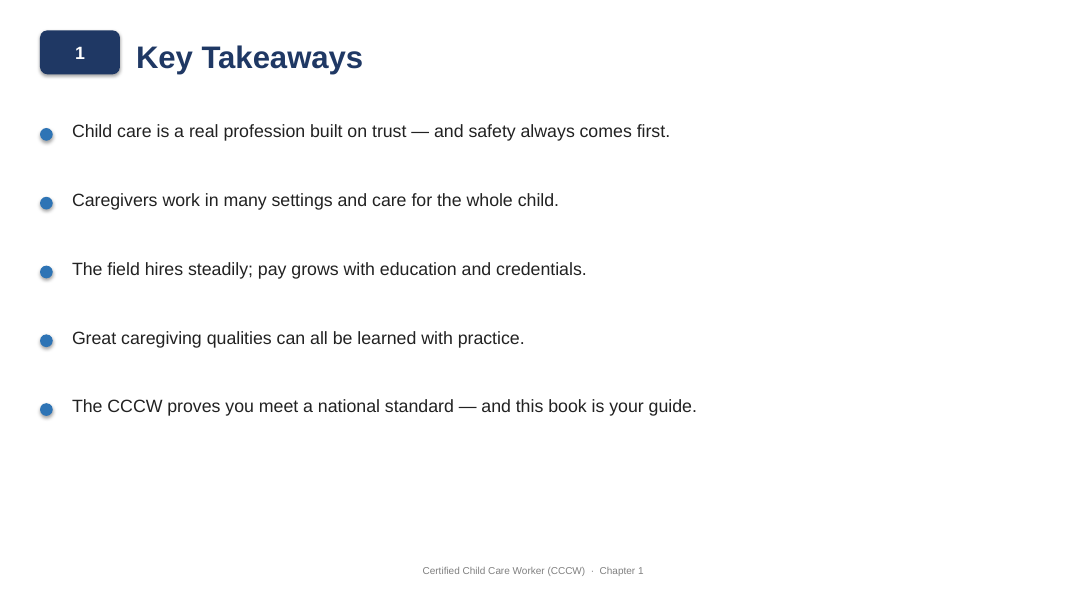
Child care work is a real profession built on trust. Each day, caregivers keep children safe, serve meals, support hygiene, plan learning activities, watch for problems, and keep records. Most of all, they care for the whole child, meeting physical, emotional, social, and learning needs all at once. This is far more than babysitting; it is early education that helps shape who children become.
Caregivers work in many settings, including child care centers, preschools, before- and after-school programs, family child care homes, and private homes as nannies. Each setting serves different ages and offers a different rhythm. With nearly one million jobs and about 160,200 openings each year, the field hires steadily, even though total employment is expected to dip slightly. Pay starts modest, around $32,050 a year on average, but rises with experience, education, and a credential, and the work offers rewards that go far beyond money.
Great caregivers share key qualities: patience and warmth, reliability, good communication, calm decision-making, physical stamina, respect for families, and a love of learning. These can all be grown with practice. The Certified Child Care Worker (CCCW) credential, offered by the NCCB, proves you have learned the core skills the field requires. This book is your guide to that credential, organized into twelve clear chapters that build your knowledge step by step. Study one chapter at a time, use the review questions, and connect each idea to real children, and you will be ready to pass the exam and grow your career.
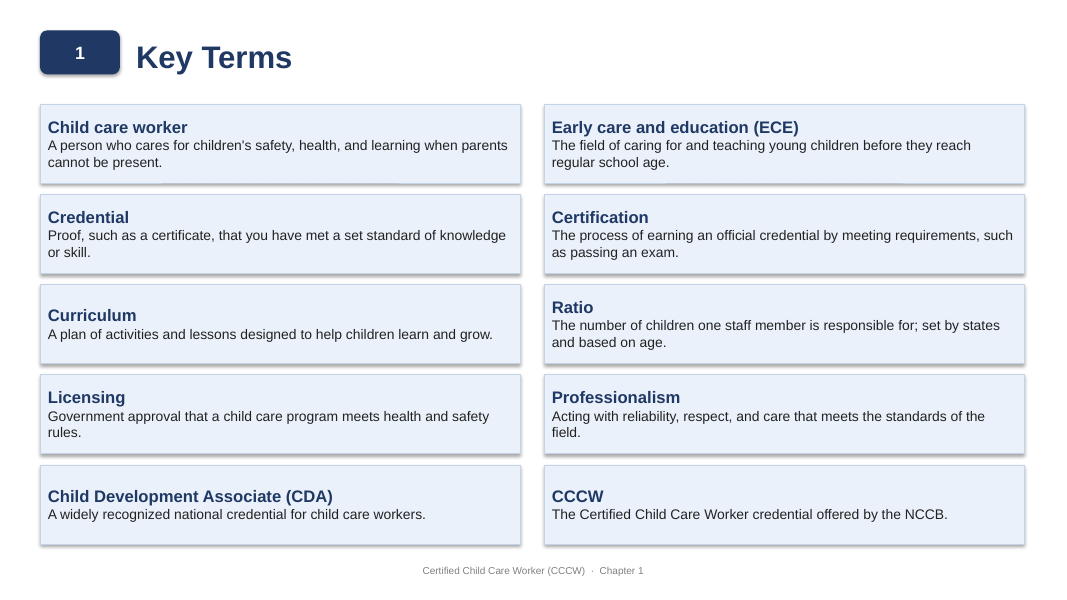

Key terms
| Term | What it means |
| Child care worker | A person who cares for children’s safety, health, and learning when parents cannot be present. |
| Early care and education (ECE) | The field of caring for and teaching young children before they reach regular school age. |
| Credential | Proof, such as a certificate, that you have met a set standard of knowledge or skill. |
| Certification | The process of earning an official credential by meeting requirements, such as passing an exam. |
| Curriculum | A plan of activities and lessons designed to help children learn and grow. |
| Ratio | The number of children one staff member is responsible for; set by states and based on age. |
| Licensing | Government approval that a child care program meets health and safety rules. |
| Professionalism | Acting with reliability, respect, and care that meets the standards of the field. |
| Child Development Associate (CDA) | A widely recognized national credential for child care workers. |
| CCCW | The Certified Child Care Worker credential offered by the NCCB. |
References
U.S. Bureau of Labor Statistics. (2025). Occupational Outlook Handbook: Childcare Workers. U.S. Department of Labor. https://www.bls.gov/ooh/personal-care-and-service/childcare-workers.htm
National Career Certification Board. (2026). Certified Child Care Worker (CCCW). https://nccboard.org/certification/professional-careers/certified-child-care-worker-cccw
Council for Professional Recognition. (2025). Child Development Associate (CDA) Competency Standards and Subject Areas. https://www.cdacouncil.org
National Association for the Education of Young Children. (2020). Developmentally Appropriate Practice position statement. https://www.naeyc.org
American Academy of Pediatrics, American Public Health Association, & National Resource Center for Health and Safety in Child Care and Early Education. Caring for Our Children: National Health and Safety Performance Standards (4th ed.). https://nrckids.org/CFOC