Chapter 1 Wrap-up
Chapter summary
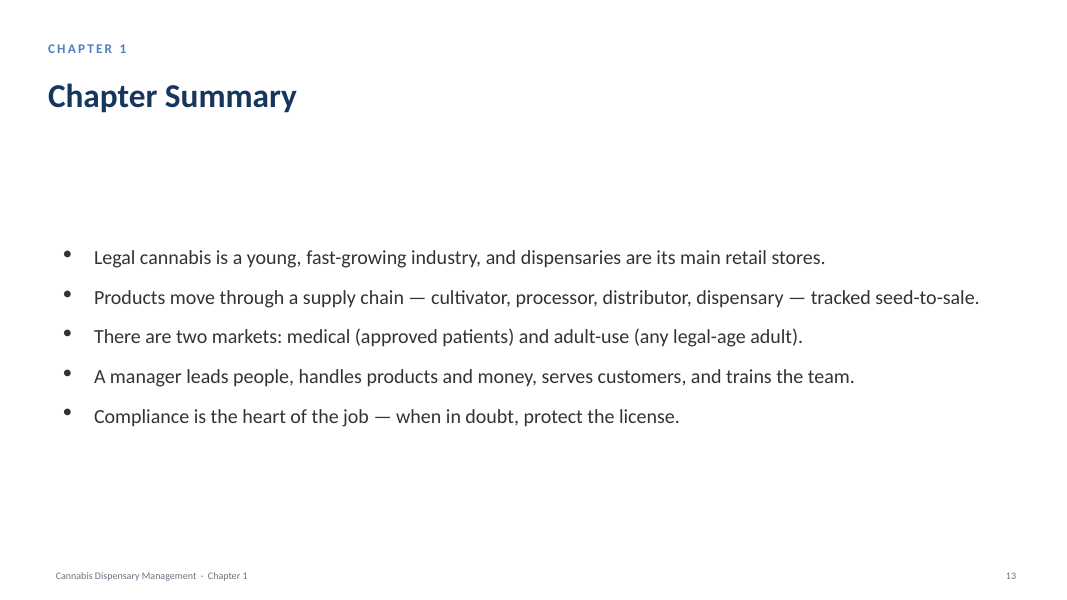
Cannabis has been part of American life for centuries. It was a farm crop, then a medicine, then a target of prohibition. The Marihuana Tax Act of 1937 and the Controlled Substances Act of 1970 changed that. Together they made cannabis a crime at the federal level and placed it in Schedule I, next to heroin and LSD. Decades of enforcement caused serious harm to communities and individuals. Public opinion began to shift in the 1990s. Then California legalized medical cannabis in 1996. That move opened a door that has since grown into a multibillion-dollar industry.
Federal cannabis prohibition has not ended. But right now, the federal government has a policy of non-interference, and it leaves state-licensed cannabis businesses alone. This legal tension creates real problems for dispensaries. They have limited access to banking, and they face an unusual federal tax burden under IRS Section 280E. As a manager, you work in this landscape every day. Understanding it helps you lead your team, and it also helps you explain the business to customers with confidence.
Legal cannabis markets come in two forms. Medical programs serve registered patients with qualifying conditions. Adult-use programs let any adult 21 or older buy without a medical card. Many states run both types at the same time. The cannabis industry supports hundreds of thousands of jobs and brings in major state tax revenue. And it includes businesses of all sizes, from large multi-state operators to small independent dispensaries.
Everything in a licensed dispensary runs on compliance. Your store exists because of a state license. That license carries daily requirements. They cover inventory, staffing, security, age verification, and recordkeeping. Violations can bring fines, suspension, or permanent revocation. Your job as a manager is clear. Build a team and a culture where compliance is not an afterthought. It is the standard everyone follows, every single day.
Key terms
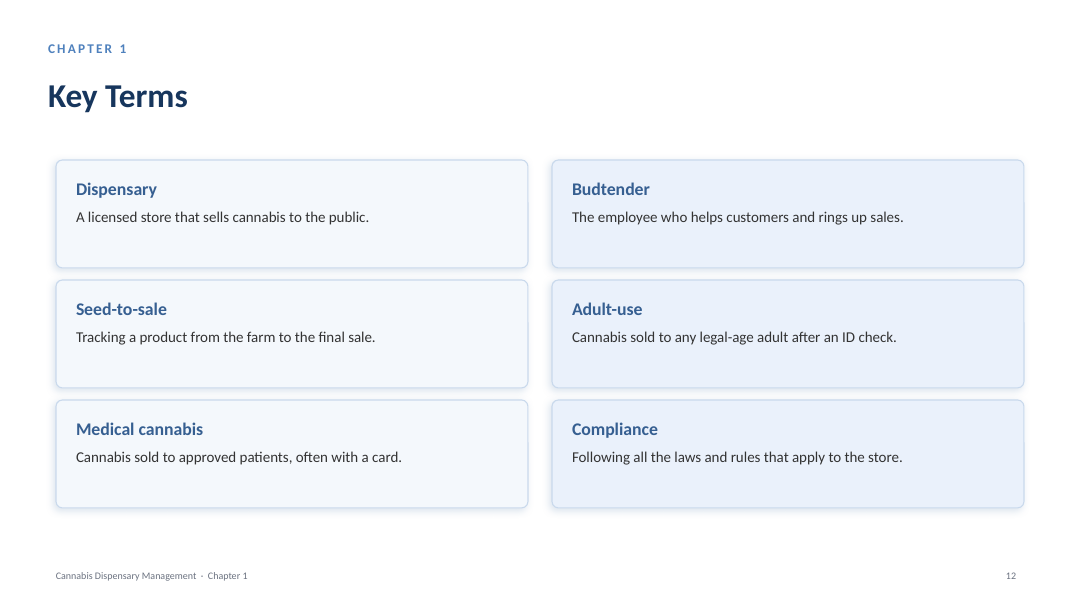
| Term | Definition |
| Schedule I | The most restrictive classification under the federal Controlled Substances Act, indicating a substance has a high potential for abuse and no currently accepted medical use. Cannabis is currently classified as Schedule I at the federal level. |
| Controlled Substances Act (CSA) | A federal law enacted in 1970 that established a scheduling system for regulating drugs and other substances based on their potential for abuse and accepted medical use. The CSA is the primary federal law under which cannabis prohibition exists. |
| Medical Cannabis | Cannabis used by registered patients for therapeutic or wellness purposes under a state-regulated medical program that requires a physician recommendation and patient registration. |
| Adult-Use Cannabis | Cannabis sold legally to any adult 21 years of age or older without a medical card or physician recommendation, in states that have passed adult-use legalization laws. |
| Dispensary | A licensed retail establishment authorized by the state to sell cannabis products to qualified customers, including medical patients, registered caregivers, and adult-use consumers depending on the license type. |
| Seed-to-Sale Tracking | A mandatory state monitoring system that tracks cannabis plants and products from the point of cultivation through processing, distribution, and final retail sale. Used by regulators to prevent diversion and ensure accountability. |
| State Regulatory Agency | The government body in each legal cannabis state responsible for licensing, regulating, and enforcing cannabis laws. Names vary by state and may include cannabis control boards, departments of cannabis control, or offices of medical cannabis. |
Review questions
1. Under which federal law is cannabis currently classified as a Schedule I controlled substance?
2. Which state became the first to legalize medical cannabis in 1996?
3. What is the minimum age to purchase cannabis in an adult-use state?
4. Which IRS tax provision prevents cannabis businesses from deducting ordinary business expenses on their federal tax returns?
5. What is a caregiver in the context of a medical cannabis program?
6. What is seed-to-sale tracking?
7. Which of the following best describes the current relationship between federal and state cannabis law?
8. What was the significance of Colorado and Washington’s 2012 ballot measures?
Chapter Activity
Part A — A Customer Asks the Hard Questions
You are the manager on duty at a licensed adult-use dispensary. A first-time customer named Robert approaches you after his purchase. He says, “I heard on the news that cannabis is still illegal at the federal level. If that’s true, why are you allowed to sell it? And what happens if the federal government decides to crack down?” Robert seems genuinely curious, not hostile. He is an educated professional. He just wants to understand what he did.
1. How would you explain the relationship between federal and state cannabis law to Robert in plain, non-alarming language?
2. What would you say to reassure Robert that your dispensary operates legally and responsibly under state law?
3. Robert also asks whether he could get in trouble for possessing what he just bought if he crosses state lines. How do you answer that question accurately and helpfully?
4. After your conversation, Robert says he feels much better informed. What does this interaction tell you about the value of industry knowledge for a dispensary manager?
Part B — Written Response
Now try this in three to five sentences. Describe how you would explain the difference between a medical cannabis program and an adult-use program. Imagine you are talking to a new employee on their first day. Use plain language. A person with no cannabis background should be able to follow it.
References
Drug Enforcement Administration (DEA). (2023). Drug Scheduling. U.S. Department of Justice. www.dea.gov/drug-information/drug-scheduling
Internal Revenue Service (IRS). (2023). IRC Section 280E and Cannabis Businesses. U.S. Department of the Treasury. www.irs.gov
National Conference of State Legislatures (NCSL). (2024). State Medical Cannabis Laws. www.ncsl.org/health/state-medical-cannabis-laws
Uniform Law Commission. (2021). Overview of Cannabis Regulation in the United States. www.uniformlaws.org
Marijuana Policy Project. (2024). State Policy. www.mpp.org/states
ProCon.org. (2024). Legal Medical Marijuana States and DC. marijuana.procon.org
U.S. Department of Justice. (2013). Guidance Regarding Marijuana Enforcement (Cole Memorandum). Office of the Deputy Attorney General.
Congressional Research Service. (2023). Cannabis: Federal and State Law. fas.org/sgp/crs/misc