Chapter 1 Wrap-up
Chapter summary
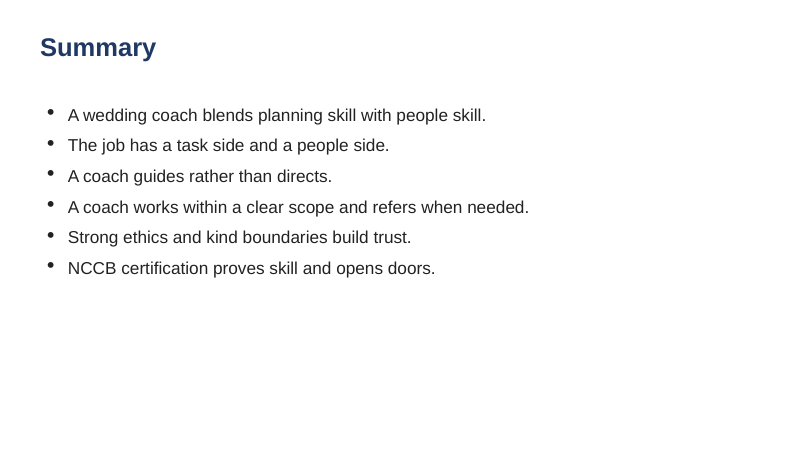
A wedding coach blends two skill sets: the planning know-how of a wedding professional and the people skills of a coach. The job has a task side — budgets, vendors, timelines, and the wedding day — and a people side — stress, decisions, family, and staying connected. The coaches couples remember are the ones who hold both sides with care.
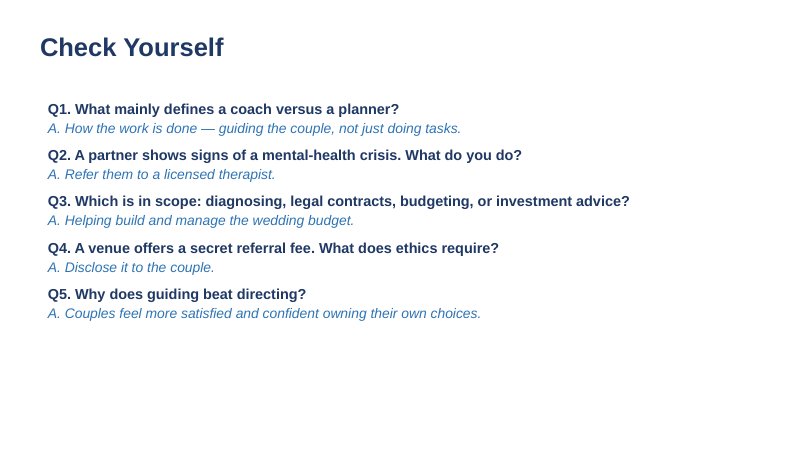
The coach is different from a planner or a coordinator. Those roles are mostly defined by when they start and how many tasks they handle. The coach is defined by how the work is done: guiding rather than directing, asking rather than telling, and leaving the couple more confident than before. This guiding mindset is the heart of the profession, and it produces happier couples and easier projects over time.
Every coach works within a scope of practice. A coach educates, supports, and guides, but does not diagnose, treat, or give licensed legal, financial, or medical advice. When a need crosses that line, the professional move is a kind referral to the right expert. Strong ethics — honesty, confidentiality, fairness, and reliability — and clear, kind boundaries are what make a coach safe to trust, especially around money and emotion.
Finally, the NCCB Certified Wedding Planner Coach credential proves your skill against a national standard. It builds client trust, supports stronger pricing, and opens doors in a steady, growing field. With the role, the mindset, the scope, and the ethics in place, you are ready to start building the practical skills the rest of this course will teach.
Key terms
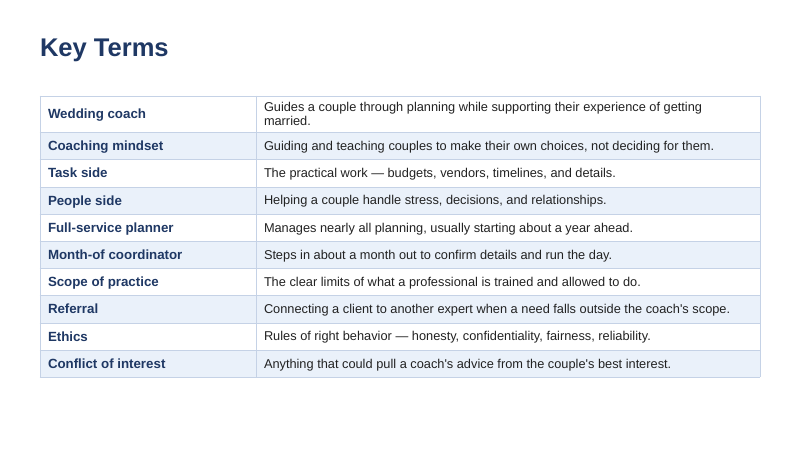
| Term | Definition |
| Wedding coach | A professional who guides a couple through wedding planning while also supporting their experience of getting married. |
| Coaching mindset | An attitude of guiding and teaching couples to make their own choices, rather than directing or deciding for them. |
| Task side | The practical, visible work of planning — budgets, vendors, timelines, and details. |
| People side | The supportive work of helping a couple handle stress, decisions, and relationships during planning. |
| Full-service planner | A professional who manages nearly all of the planning, usually starting about a year before the wedding. |
| Month-of coordinator | A professional who steps in about a month before to confirm details and run the wedding day. |
| Scope of practice | The clear limits of what a professional is trained and allowed to do. |
| Referral | Connecting a client to another qualified professional when a need falls outside the coach’s scope. |
| Ethics | The rules of right behavior — honesty, confidentiality, fairness, and reliability — that guide a profession. |
| Conflict of interest | Anything that could pull a coach’s advice away from the couple’s best interest, such as a hidden vendor fee. |
References
National Career Certification Board. (2026). Certified Wedding Planner Coach (CWPC) and Professional Coaching Careers. nccboard.org.
U.S. Bureau of Labor Statistics. (2025). Occupational Outlook Handbook: Meeting, Convention, and Event Planners. bls.gov.
International Coaching Federation. (2025). ICF Code of Ethics and Core Competencies. coachingfederation.org.
Association of Bridal Consultants. (2025). Professional roles in wedding planning and coordination. bridalassn.com.