Chapter 1 Wrap-up
Chapter summary
A nutritional coach guides and supports people as they build healthy eating habits that last. The coach is a partner, not a boss, using a client-centered approach that helps people create plans they believe in and will actually follow.
Coaching is different from related roles. Nutritionists advise on food with training that varies by state, registered dietitians treat medical conditions with food, and doctors diagnose and prescribe. Knowing these differences keeps clients safe and helps you refer well.
Demand for coaches is strong and growing. Information overload and lifestyle disease have created a real need for trustworthy guidance, and coaches work in gyms, clinics, corporate wellness, schools, and private practice, both in person and online.
The most important idea in this chapter is scope of practice: coaches teach healthy habits and build routines, but they do not diagnose, treat disease, or provide medical nutrition therapy. When a client’s needs go beyond healthy habits, the professional choice is to refer out. Protect your clients’ trust through honesty, clear boundaries, and care, and the rest of your coaching will rest on a solid foundation.
Take a moment to notice how much of this chapter is about people rather than food. We talked about listening, trust, partnership, and knowing your limits long before we mentioned a single nutrient. That is on purpose. The science of nutrition matters, and you will learn plenty of it in the chapters ahead, but science alone does not change behavior. People do, with the help of a coach who understands them.
As you continue, keep checking your understanding against the five learning objectives at the start of this chapter. Can you define nutritional coaching, explain how it differs from related roles, name the settings where coaches work, describe your scope of practice, and recognize when to refer? If any of these feels shaky, return to that section before moving on. A strong foundation here will make everything that follows easier to learn and easier to use with real clients.
Finally, remember that becoming a great coach is itself a journey of small, steady steps — the very thing you will teach your clients. You will not master everything at once, and you do not need to. Read with curiosity, practice the skills as you learn them, and be as patient with yourself as you will be with the people you serve. The fact that you are here, building a strong foundation, already says a great deal about the coach you are going to be.
Keep this chapter in mind as a compass. As the science gets more detailed in the chapters ahead, the heart of the work stays the same: listen first, guide gently, respect your limits, and put the client at the center. A coach who never forgets these basics will always have a place in the lives of the people they serve.
Chapter 1 Activity: Defining Your Coaching Role
This activity helps you put the chapter’s ideas into practice. Work through both parts on your own or with a study partner.
Part A: In or Out of Scope?
For each situation below, decide whether the action is inside or outside a nutritional coach’s scope of practice. Write “In” or “Out,” then explain your reasoning in one sentence.
Scenario Set
1. A client asks for help building a habit of packing a healthy lunch for work.
2. A client wants you to adjust the dose of their diabetes medication.
3. A client recovering from surgery asks you to design a medical meal plan for their condition.
4. A client asks for simple, general tips to add more vegetables to dinner.
5. A client describes a long pattern of skipping meals and a fear of eating.
Part B: Your Scope Statement
Write a short scope-of-practice statement, in your own words, that you could share with a new client. In two or three sentences, explain what you help with and where you draw the line. Keep it warm, clear, and honest.
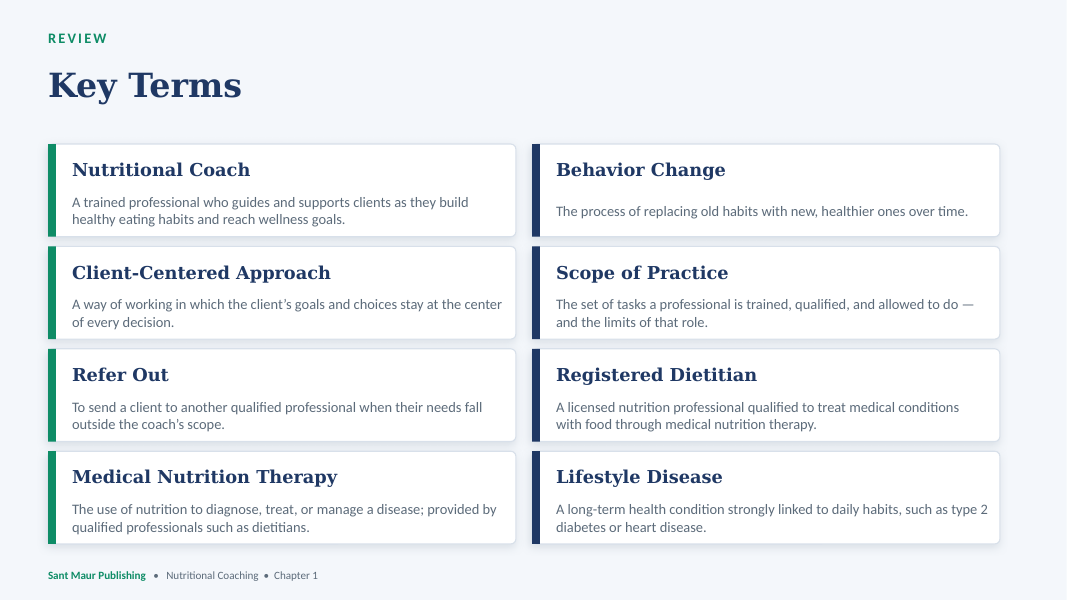
Key terms
| Term | Definition |
| Nutritional Coach | A trained professional who guides and supports clients as they build healthy eating habits and reach wellness goals. |
| Behavior Change | The process of replacing old habits with new, healthier ones over time. |
| Client-Centered Approach | A way of working in which the client’s goals and choices stay at the center of every decision. |
| Scope of Practice | The set of tasks a professional is trained, qualified, and allowed to do — and the limits of that role. |
| Refer Out | To send a client to another qualified professional when their needs fall outside the coach’s scope. |
| Registered Dietitian | A licensed nutrition professional qualified to treat medical conditions with food through medical nutrition therapy. |
| Medical Nutrition Therapy | The use of nutrition to diagnose, treat, or manage a disease; provided by qualified professionals such as dietitians. |
| Lifestyle Disease | A long-term health condition strongly linked to daily habits, such as type 2 diabetes or heart disease. |
References
National Career Certification Board. Nutritional Coach Certification (CNC). nccboard.org.
U.S. Bureau of Labor Statistics. Occupational Outlook Handbook: Dietitians and Nutritionists. bls.gov.
American Nutrition Association. Nutrition Regulations by Profession. theana.org.
National Association of Nutrition Professionals. Scope of Practice. nanp.org.
American Council on Exercise. Position Statement on Nutrition Scope of Practice for Exercise Professionals. acefitness.org.
Academy of Nutrition and Dietetics. Scope of Practice for the Registered Dietitian. eatrightpro.org.