Chapter 1 Wrap-up
Chapter summary
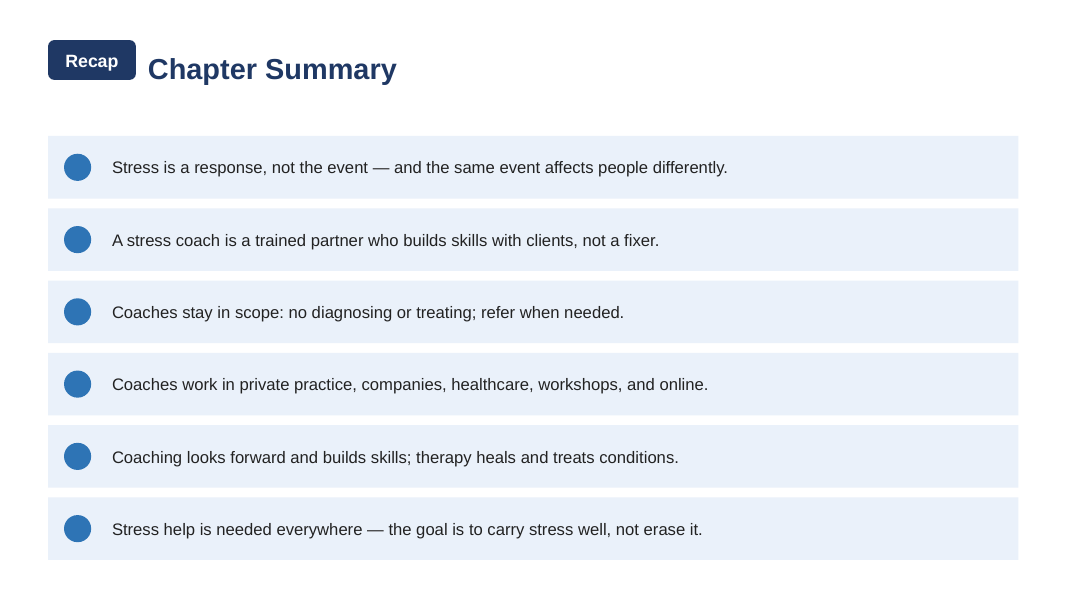
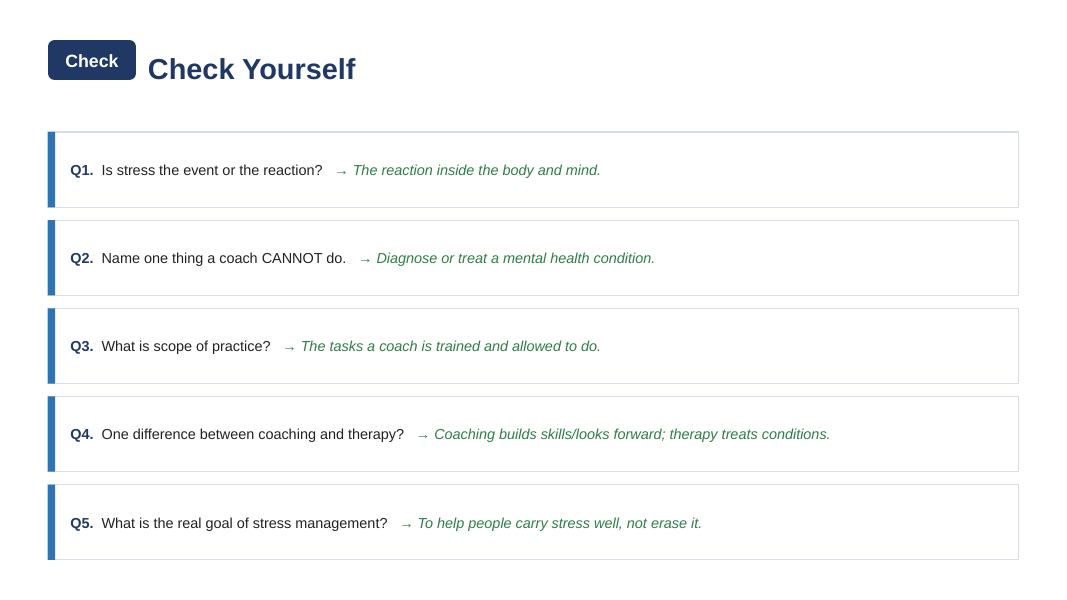
Stress is something every person knows from the inside, yet few people are ever taught what it really is. In this chapter, you learned that stress is a response, not the event itself. The thing that sets it off is called a stressor, and the same stressor can affect two people in very different ways. Stress shows up in the body, the mind, and our actions, much like a smoke alarm that grabs our attention so we will act. We also cleared away four common myths: that all stress is bad, that stress is “all in your head,” that strong people never feel it, and that you should handle it alone.
You also learned what a stress management coach does. You are a trained partner who helps people build real skills, working with them rather than doing things to them. Just as important, you learned what a coach does not do. You do not diagnose, treat, or give medical advice. Staying inside your scope of practice and referring clients when needed is a sign of a caring, professional coach.
We looked at where stress coaches work — in private practice, in companies, in healthcare and wellness centers, and in workshops and community groups — and at the key differences between coaching, counseling, and therapy. Coaching looks mostly forward and builds skills, while therapy often heals deeper wounds and treats mental health conditions. The space between them, the “gray area,” is where your judgment and your willingness to refer matter most.
Finally, you saw why this work matters so much right now. Modern life keeps us “on” all the time, and trusted health organizations agree that stress and burnout are serious, growing problems. That makes skilled stress coaches genuinely needed in nearly every part of life. Remember the idea we started with: the goal is not to erase stress, but to help people carry it well. That is the work you are now beginning to learn.
Key terms
| Term | What it means |
| Stress | The body and mind’s reaction to a demand or challenge. |
| Stressor | Any demand or challenge that sets off the stress response. It can be outside us or inside our own thoughts. |
| Stress response | The set of changes in the body, mind, and behavior that happen when we face a stressor. |
| Stress management coach | A trained partner who helps people understand their stress and build practical skills to handle it. |
| Scope of practice | The set of tasks a professional is trained and allowed to do — and the limits they must respect. |
| Referral | Sending a client to another professional, such as a therapist or doctor, when their needs go beyond coaching. |
| Burnout | A state of deep exhaustion caused by long-term, unmanaged stress, often from work. |
| Coaching partnership | The shared, side-by-side working relationship between a coach and a client. |
References
-
American Psychological Association. Stress in America survey series. apa.org.
-
World Health Organization. “Burn-out an ‘occupational phenomenon’: International Classification of Diseases (ICD-11).” who.int.
-
National Institute for Occupational Safety and Health (NIOSH), Centers for Disease Control and Prevention. Workplace stress resources. cdc.gov/niosh.
-
National Career Certification Board. Certified Stress Management Coach (CSMC) program information. nccboard.org.
-
International Coaching Federation. Coaching definitions and ethical guidelines. coachingfederation.org.