Chapter 1 Wrap-up
Chapter summary
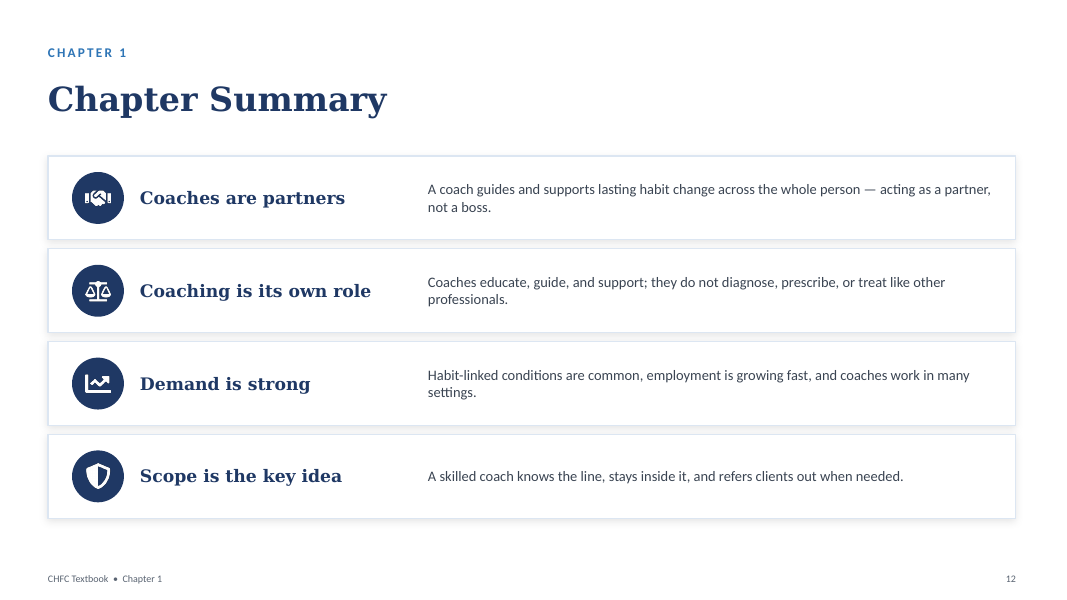
A health and fitness coach guides and supports people as they build healthier habits. This work covers areas like exercise, nutrition, sleep, and stress. The best coaches act as partners, not bosses, keeping the client at the center of every decision. They focus on lasting behavior change rather than quick fixes, and they look at the whole person instead of just one piece of health.
Coaching is different from several related roles. Personal trainers lead workouts, dietitians treat nutrition problems, therapists treat mental health conditions, and doctors diagnose and prescribe. Coaches educate, guide, and support, but they do not diagnose, prescribe, or treat. Knowing these differences keeps clients safe and keeps coaches working as trusted professionals.
Demand for coaches is strong and growing. Many common health problems are tied to daily habits, and coaches help people turn good intentions into steady action. Employment is projected to grow much faster than average, and pay rises with experience and credentials. Coaches work in many settings, including gyms, clinics, corporate wellness programs, private practice, and online.
The most important idea in this chapter is scope of practice. It is the line between what a coach is allowed to do and what belongs to other professionals. A skilled coach knows that line, stays inside it, and refers clients out when needed. With this foundation in place, you are ready to explore the science and skills that make great coaching possible in the chapters ahead.
Chapter 1 Activity: Defining Your Coaching Role
This activity helps you put the chapter’s ideas into practice, and begin shaping how you will explain your work to future clients.
Part A: In or Out of Scope?
For each situation below, decide whether the action is inside a coach’s scope of practice or outside it. If it is outside, name the professional the client should be referred to.
Scenario Set
-
1. A client asks for help building a habit of walking after dinner.
-
2. A client wants you to adjust the dose of their diabetes medication.
-
3. A client recovering from knee surgery asks you to design a rehab plan before seeing their doctor.
-
4. A client asks for simple, general tips to add more vegetables to meals.
-
5. A client describes feeling hopeless and uninterested in life for several weeks.
Part B: Your Scope Statement
Write a short scope-of-practice statement, in your own words, that you could share with a new client. It should explain what you do, what you do not do, and what you will do if a need falls outside your scope. Keep it friendly and clear, using about three to five sentences.
Key terms
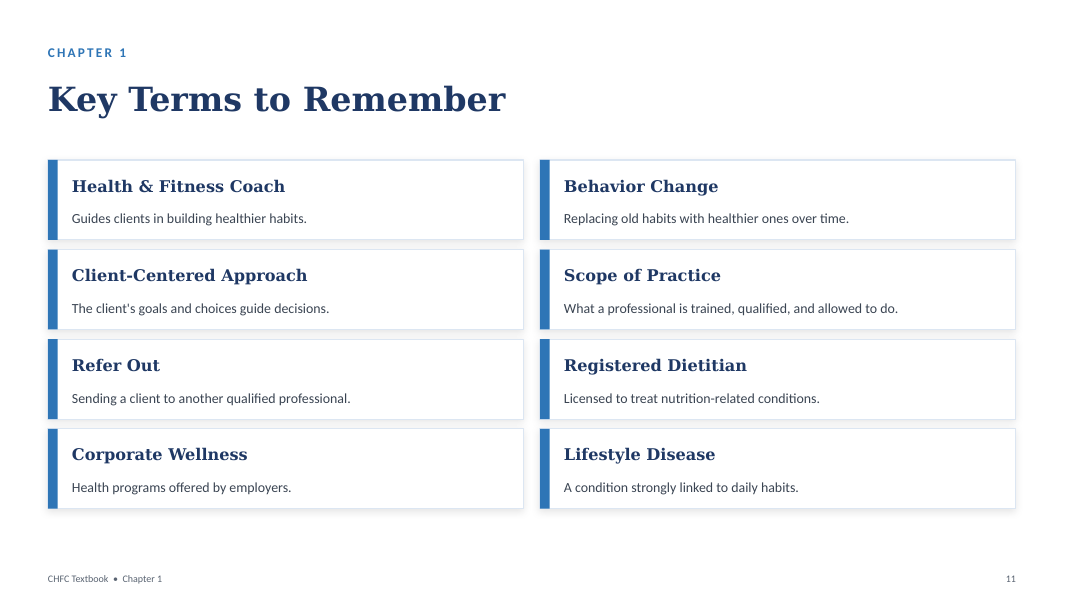
| Term | Definition |
| Health and Fitness Coach | A trained professional who guides and supports clients as they build healthier habits in areas like exercise, nutrition, and lifestyle. |
| Behavior Change | The process of replacing old habits with new, healthier ones over time. |
| Client-Centered Approach | A way of working in which the client’s goals and choices guide every decision. |
| Scope of Practice | The set of tasks a professional is trained, qualified, and allowed to perform. |
| Refer Out | To send a client to another qualified professional when their needs fall outside your scope. |
| Registered Dietitian | A licensed nutrition professional qualified to treat nutrition-related health problems and create medical meal plans. |
| Corporate Wellness | Health programs offered by employers to help employees stay healthy. |
| Lifestyle Disease | A long-term health condition strongly linked to daily habits, such as type 2 diabetes or heart disease. |
Review questions
The following questions are written in a style consistent with the CHFC examination. Choose the best answer for the multiple-choice items, and answer the short-response items in your own words.
| 1. | A health and fitness coach’s main role is best described as: (a) telling clients exactly what to eat and how to exercise; (b) guiding and supporting clients as they build their own healthy habits; (c) diagnosing health problems and recommending treatment; (d) prescribing supplements to speed up results. |
| 2. | During a session, a client mentions chest pain and dizziness during their last workout. What is the most appropriate action for the coach? (a) suggest a lighter workout next time; (b) guess the likely cause and reassure the client; (c) stop activity and refer the client to a doctor; (d) recommend a supplement for heart health. |
| 3. | Which task is OUTSIDE a health and fitness coach’s scope of practice? (a) encouraging a client to drink more water; (b) helping a client set a weekly walking goal; (c) creating a medical meal plan to treat a client’s diabetes; (d) supporting a client in following their doctor’s plan. |
| 4. | Explain, in your own words, the difference between a health and fitness coach and a personal trainer. Give one example of something each one would do. |
| 5. | Why does clearly explaining your scope of practice to a new client tend to build trust rather than reduce it? Describe what you would say to a client who asks you to do something outside your scope. |
References
National Career Certification Board. Health & Fitness Coach Certification (CHFC). https://nccboard.org/certification/professional-coaching-careers/health-fitness-coach-certification-chfc
U.S. Bureau of Labor Statistics. Occupational Outlook Handbook: Fitness Trainers and Instructors. https://www.bls.gov/ooh/personal-care-and-service/fitness-trainers-and-instructors.htm
National Board for Health & Wellness Coaching. Scope of Practice. https://nbhwc.org/scope-of-practice/
International Sports Sciences Association. What Is the Scope of Practice for a Health Coach? https://www.issaonline.com/blog/post/what-is-the-scope-of-practice-for-a-health-coach