Chapter 1 Wrap-up
Chapter summary
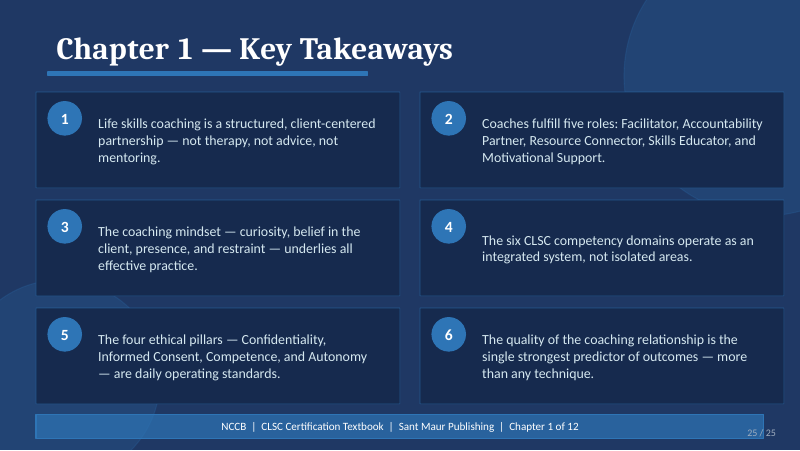
Chapter 1 has built the foundation for every chapter that follows. You now know what life skills coaching is. It is a structured, client-centered, forward-focused partnership. You know how it differs from therapy, mentoring, consulting, and teaching. You have explored the five roles a coach fills. These are facilitator, accountability partner, resource connector, skills educator, and motivational support. And you have explored the coaching mindset behind all of them: curiosity, belief in the client, presence, and restraint.
You have met the six CLSC competency domains. They are Communication and Interpersonal Skills, Goal Setting and Self-Management, Emotional Intelligence, Problem Solving and Critical Thinking, Health and Wellness, and Workplace Professionalism. You have begun to see how they work as one integrated system, not as separate areas. This chapter’s coaching scenarios were Marcus and Yolanda. They show both the entry points for coaching and the connected nature of life skill challenges.
You have examined the four pillars of the NCCB Code of Professional Conduct. They are confidentiality, informed consent, competence and scope of practice, and respect for client autonomy. You have also stretched that ethical framework to include cultural competence and self-care. And you have explored the coaching relationship itself. You have seen how trust is built, what a coaching agreement holds, and how a standard coaching session is structured.
These foundations are not background material to set aside as you move ahead. They are the lens for judging every technique, framework, and client interaction. Return to them often.
Chapter 1 Activity: Defining Your Coaching Stance
This activity helps you start building your personal coaching identity. That identity is the set of values, principles, and commitments that will shape your practice as a Certified Life Skills Coach.
Part A: Coaching vs. Other Helping Roles — Scenario Analysis
Read each scenario below. Decide whether the response fits coaching or reflects a different helping role. That other role might be therapist, mentor, consultant, or teacher. Briefly explain your reasoning.
-
A client shares that she has struggled to find motivation. She lost a close family member six months ago. The helper responds: “It sounds like you may still be in a grief process. I want to recommend you work with a therapist to process this loss, and we can coordinate on how coaching might still support your goals.”
-
A client is unsure how to format a professional resume. The helper spends thirty minutes showing the client exactly how to structure each section. The helper uses examples from their own career.
-
A client wants to change careers. The helper asks: “What does success in a new career look like to you? What strengths do you bring? What would help you feel confident taking the first step?”
-
A client has been called to a disciplinary hearing at work. The helper says: “In my experience in HR, the most important thing you can do is document everything. Here is what I would do in your situation.”
Part B: My Coaching Stance Statement
Use what you have learned in this chapter. Write a personal Coaching Stance Statement. It should be a short paragraph of 100 to 150 words. Describe the coach you intend to be. Include your commitment to the coaching mindset: curiosity, belief in the client, presence, and restraint. Include your approach to professional ethics. And include the clients or populations you feel most called to serve.
There is no single right answer. This statement should be true to you. You will likely revisit and revise it as your coaching practice grows. That is a sign of growth, not inconsistency.
Part C: Ethical Decision-Making
Read the situation below and answer the questions that follow:
Scenario
You are three sessions into coaching a client named David. He is working to re-enter the workforce after a period of incarceration. In today’s session, David becomes very emotional. He discloses that he has been having thoughts of harming himself. He says he has no specific plan and does not intend to act on them. He asks you to keep this between the two of you.
-
What are your ethical duties in this situation?
-
How does this situation relate to the scope of practice of a Life Skills Coach?
-
What would you say to David in this moment?
-
What systems or resources would a well-prepared coach have in place before a situation like this comes up?
Key terms
| Term | Definition |
| Life Skills Coaching | A structured, client-centered process in which a trained coach helps an adult develop practical competencies across key life domains. |
| CLSC | Certified Life Skills Coach — the professional certification issued by the National Career Certification Board (NCCB). |
| Coaching Stance | The fundamental mindset of a coach: curious, non-judgmental, present, and committed to the client’s autonomous growth. |
| Scope of Practice | The boundaries of a coach’s role, defined by training, certification, and professional ethics. |
| Informed Consent | The process by which a client voluntarily agrees to coaching after being fully informed of its nature, scope, methods, and their rights. |
| Confidentiality | The ethical obligation to keep all client information private, except in legally mandated circumstances. |
| Competency Domain | One of six defined areas of life skill (Communication, Goal Setting, Emotional Intelligence, Problem Solving, Health and Wellness, Workplace Professionalism) assessed by the CLSC examination. |
| Dual Relationship | A situation in which the coach has another type of relationship with the client (supervisor, friend, family member) that may compromise objectivity. |
| Cultural Competence | The ability to recognize, respect, and respond effectively to the diverse cultural backgrounds and contexts of clients. |
| Trust Triangle | A framework for understanding trust as the product of three conditions: competence, caring, and consistency. |
| Coaching Agreement | A formal document establishing the practical terms and expectations of the coaching relationship. |
| Referral | The professional practice of directing a client to another qualified professional when their needs exceed the coach’s scope of practice. |
| Autonomy | A client’s right to make their own choices about their own life, which the coach is obligated to respect and protect. |
| Accountability | In coaching, the structure that holds a client to the commitments they have made — provided supportively and without judgment. |
Review questions
The questions below match the style of the CLSC exam. For each multiple-choice question, select the best answer. For the open-ended questions, write a concise response.
| 1. | A Life Skills Coach’s primary tool for helping clients achieve their goals is: (a) Giving expert advice based on the coach’s personal experience; (b) Providing a structured, question-based process that helps clients discover their own solutions; (c) Diagnosing the client’s psychological barriers and designing treatment plans; (d) Designing a curriculum of life skills lessons and delivering them to the client. |
| 2. | A client has been working with you for four weeks toward a goal of improving her workplace communication. In today’s session, she begins describing symptoms that sound consistent with major depression: persistent sadness for over two months, loss of interest in activities she used to enjoy, difficulty concentrating, and disrupted sleep. What is the most appropriate next step for you as her Life Skills Coach? |
| 3. | Which of the following best describes the difference between the ‘Facilitator’ and ‘Skills Educator’ roles of a Life Skills Coach? When would a coach move from one role to the other? |
| 4. | The four pillars of the NCCB Code of Professional Conduct are: (a) Transparency, Fairness, Accuracy, and Diligence; (b) Confidentiality, Informed Consent, Competence, and Respect for Autonomy; (c) Goal Setting, Feedback, Accountability, and Referral; (d) Active Listening, Empathy, Boundaries, and Self-Care. |
| 5. | In your own words, explain why the coaching mindset element of ‘restraint’ — specifically the discipline of not giving advice or solving the client’s problems — is important to effective coaching. What does the coach risk losing if they abandon this discipline? |
References
Grant, A. M. (2003). The impact of life coaching on goal attainment, metacognition and mental health. Social Behavior and Personality, 31(3), 253–264.
International Coaching Federation. (2021). ICF core competencies. https://coachingfederation.org/credentials-and-standards/core-competencies
Passmore, J. (Ed.). (2016). Excellence in coaching: The industry guide (3rd ed.). Kogan Page.
Whitmore, J. (2017). Coaching for performance: The principles and practice of coaching and leadership (5th ed.). Nicholas Brealey Publishing.
Williams, P., & Anderson, S. K. (2006). Law and ethics in coaching: How to solve and avoid difficult problems in your practice. Wiley.
Notes