Chapter 1 Wrap-up
Chapter summary
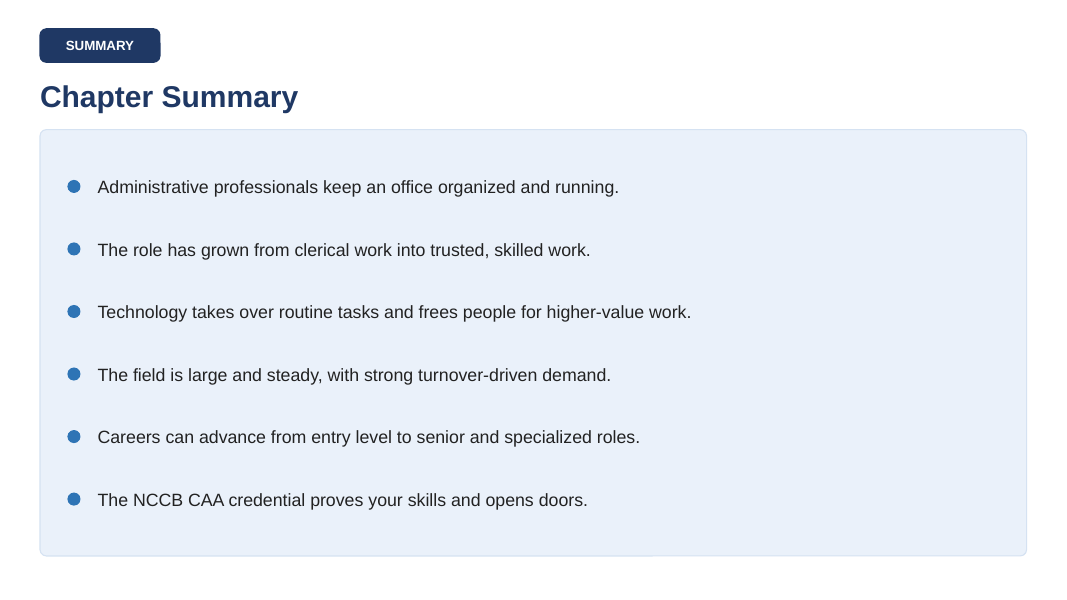
Administrative professionals are the people who keep an office organized and running smoothly. They manage calendars, prepare documents, handle communication, keep records, and take care of the many small tasks that add up to a well-run workplace. Once seen as simple clerical work, the role today calls for real judgment, problem solving, and trust. Skilled administrative professionals act as the operations hub that connects people, tasks, and information.
The role has changed a great deal over the past century, driven mostly by technology. Typewriters gave way to computers, paper files gave way to cloud storage, and today automation and AI tools are handling routine tasks. Through every change, one thing has stayed the same: administrative professionals make it possible for others to do their best work. New tools do not replace that mission. They simply free the professional to focus on higher-value work.
The job market for this field is large and steady. In 2024, about 3.45 million people worked as secretaries and administrative assistants, with a median wage of $47,460 per year. While overall employment is expected to hold steady through 2034, about 358,300 openings are expected each year as workers retire or move on. The wide pay range, from under $33,840 to over $76,550, shows that skills, experience, and credentials can move a worker toward the top of the field.
Administrative work can be a starting point or a lifelong career. Workers can move from entry-level roles into senior positions like executive assistant or office manager, specialize in fields like law or medicine, or step into related careers in operations and human resources. One of the clearest ways to advance is to earn a national certification. The NCCB Certified Administrative Assistant, or CAA, credential proves your skills to employers, helps you stand out, and can lead to higher pay. This book will prepare you, chapter by chapter, to earn it.
Key terms
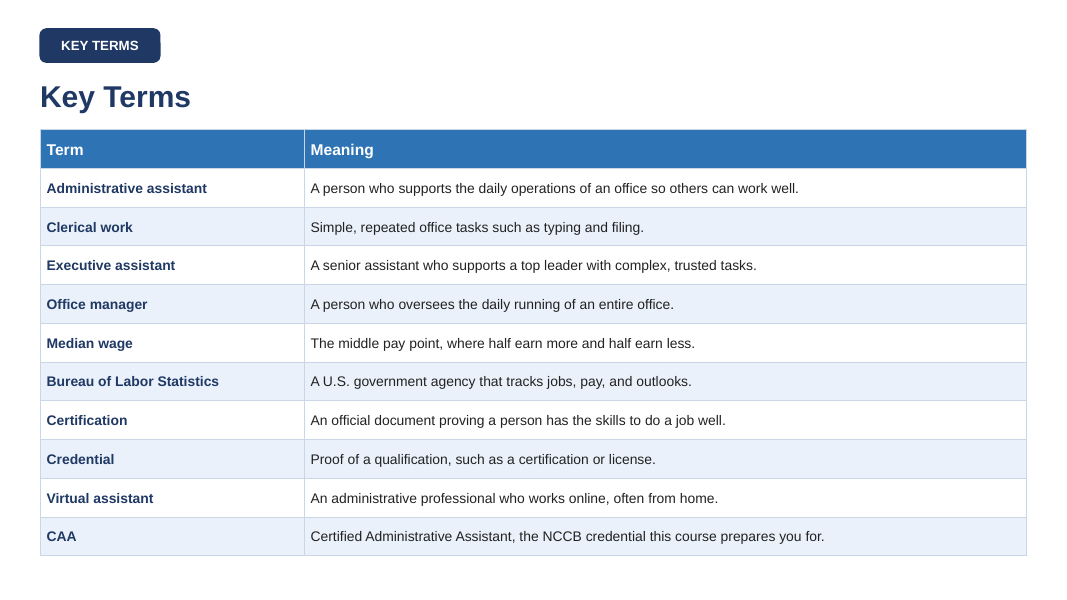
Review these key terms from the chapter. You will see them again throughout the book and on the certification exam.
| Term | Plain-Language Meaning |
| Administrative assistant | A person who supports the daily operations of an office so others can do their work well. |
| Clerical work | Simple, repeated office tasks such as typing and filing. |
| Executive assistant | A senior assistant who supports a top leader and handles complex, trusted tasks. |
| Office manager | A person who oversees the daily running of an entire office. |
| Median wage | The middle pay point, where half of workers earn more and half earn less. |
| Bureau of Labor Statistics (BLS) | A U.S. government agency that tracks jobs, pay, and career outlooks. |
| Certification | An official document proving a person has the skills to do a job well. |
| Credential | Proof of a qualification, such as a certification or license. |
| NCCB | The National Career Certification Board, which offers the CAA credential. |
| CAA | Certified Administrative Assistant, the NCCB credential this book prepares you for. |
| Virtual assistant | An administrative professional who works online, often from home. |
References
U.S. Bureau of Labor Statistics. (2025). Secretaries and Administrative Assistants. Occupational Outlook Handbook. U.S. Department of Labor. Retrieved from https://www.bls.gov/ooh/office-and-administrative-support/secretaries-and-administrative-assistants.htm
National Career Certification Board. (2026). Administrative Assistant Certification (CAA). Retrieved from https://nccboard.org/certification/professional-careers/administrative-assistant-certification-caa
U.S. Bureau of Labor Statistics. (2026). Industry and Occupational Employment Projections Overview and Highlights, 2024-34. Monthly Labor Review. U.S. Department of Labor.