Chapter 1 Wrap-up
Chapter summary
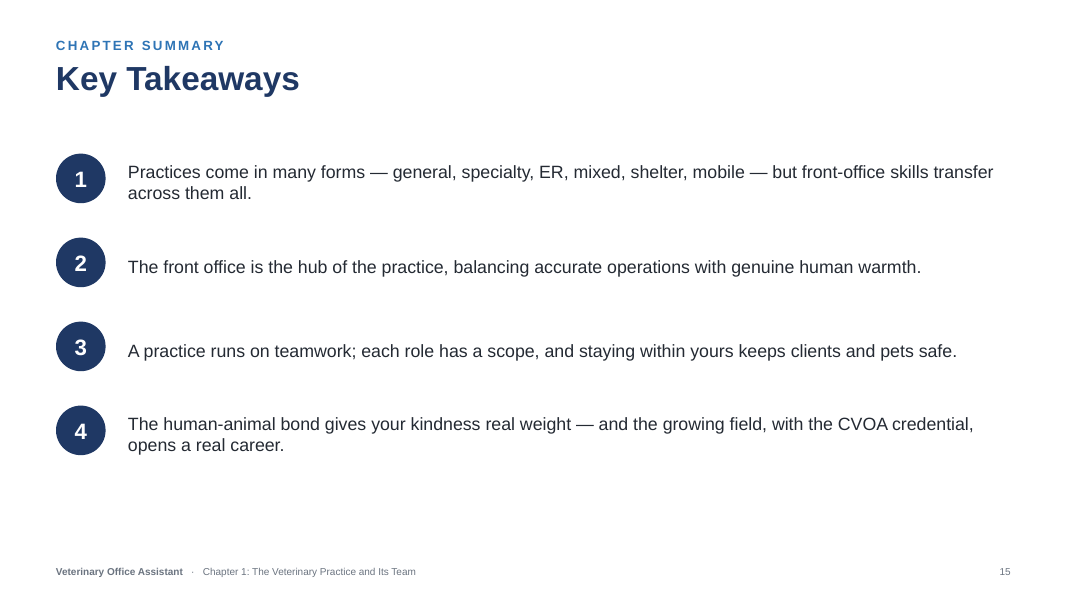
Veterinary practices come in many forms, from general clinics and mixed-animal practices to specialty hospitals, emergency centers, shelters, and mobile units. Each setting has its own pace, but the core front-office skills of greeting, scheduling, record-keeping, and billing carry across all of them. Knowing the practice type helps you picture the job and choose where you fit.
The front office is the hub of the practice. Like the center of a wheel, it connects clients, veterinarians, technicians, the pharmacy, and the cash drawer. You are the first face a client sees and the last goodbye they hear. The role has a dual nature: it demands accurate operations and genuine human warmth at the same time.
A veterinary practice runs on teamwork. Veterinarians diagnose and prescribe, technicians provide nursing care, assistants support hands-on tasks, and the office assistant runs the front. Each role has a scope, and staying within yours keeps clients and pets safe. Clean hand-offs and clear communication are how the whole team delivers one correct message.
At the heart of it all is the human-animal bond, the deep connection between people and their pets. That bond explains the strong emotions in a veterinary lobby and gives your kindness real weight. The field is growing, the pay rises with skill and experience, and the CVOA credential lets you prove what you know. The chapters ahead will build each of these skills, one at a time.
Key terms
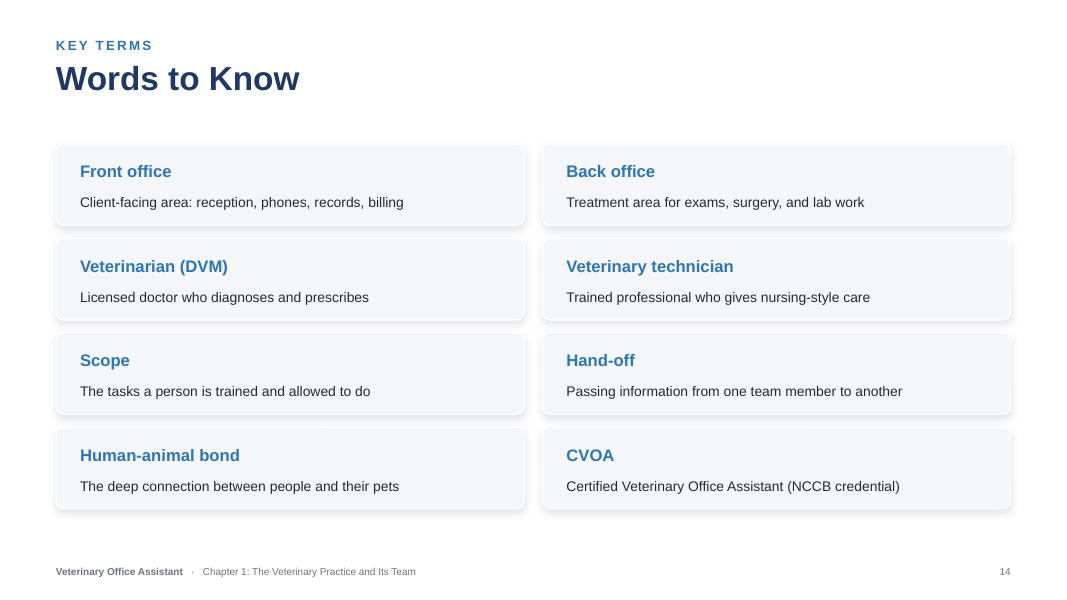
| Term | Plain-language meaning |
| Veterinary practice | A business where veterinary medicine is provided. |
| Front office | The client-facing area: reception, phones, scheduling, records, and billing. |
| Back office (treatment area) | The area where exams, surgery, and lab work take place. |
| General practice | A clinic that provides routine wellness and sick care for pets. |
| Specialty / referral hospital | A hospital with experts who treat pets referred by other clinics. |
| Emergency practice | A clinic that handles urgent, after-hours cases. |
| Veterinarian (DVM) | The licensed doctor who diagnoses, prescribes, and performs surgery. |
| Veterinary technician | A trained professional, like a nurse, who gives nursing and clinical care. |
| Veterinary assistant | A team member who supports technicians and doctors with hands-on tasks. |
| Practice manager | The person who oversees the business side of the practice. |
| Scope | The set of tasks a person is trained and allowed to perform. |
| Hand-off | Passing information from one team member to another. |
| Human-animal bond | The deep emotional connection between people and their animals. |
| CVOA | Certified Veterinary Office Assistant, a certification from NCCB. |
References
U.S. Bureau of Labor Statistics. (2025). Veterinary Assistants and Laboratory Animal Caretakers. Occupational Outlook Handbook. https://www.bls.gov/ooh/healthcare/veterinary-assistants-and-laboratory-animal-caretakers.htm
National Career Certification Board. (2026). Veterinary Office Assistant Certification (CVOA). https://nccboard.org/
American Veterinary Medical Association. (2025). The human-animal bond. https://www.avma.org/
Prendergast, H. (2019). Front Office Management for the Veterinary Team (3rd ed.). Elsevier.